
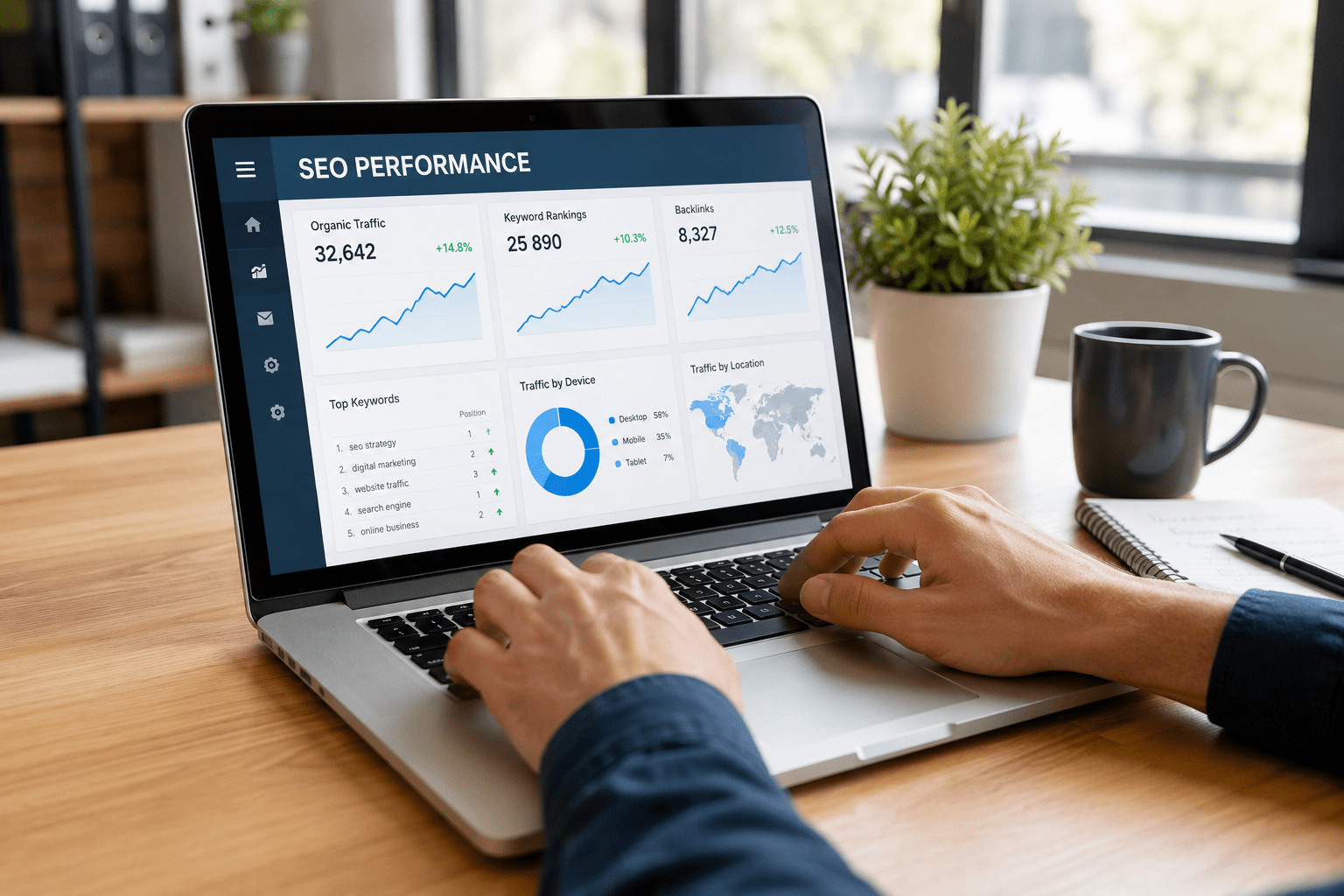
Key Takeaways:
- SEO remains essential in 2026, but businesses must also optimise for AI-powered search platforms such as ChatGPT, Google AI Overviews, Perplexity, Gemini, and Claude through Generative Engine Optimisation (GEO).
- Strong search performance depends on solid SEO fundamentals, including high-quality content, technical optimisation, fast page speeds, effective internal linking, and authoritative backlinks.
- GEO focuses on making content more likely to be cited by AI, using techniques such as question-based headings, concise answer summaries, expert quotes, sourced statistics, comparison tables, FAQs, and regular content updates.
- Website speed and user experience directly affect both rankings and conversions, with Core Web Vitals, mobile performance, and fast loading times playing a significant role in search visibility.
- Building online authority requires more than content alone—high-quality backlinks, positive customer reviews, thought leadership, and strong E-E-A-T (Experience, Expertise, Authoritativeness, and Trustworthiness) all contribute to improved visibility.
- A successful digital marketing strategy combines SEO, GEO, technical optimisation, quality content, and authority building to increase visibility across both traditional search engines and AI-powered search platforms.
Getting more traffic to your website in 2026 requires understanding two converging realities: traditional search engines still deliver the majority of organic visits, and AI-powered answer engines, ChatGPT, Perplexity, Google’s AI Overviews, and Gemini, are rapidly changing how people discover businesses online. The good news is that the fundamentals which make content rank on Google are largely the same fundamentals that make AI systems cite your business as a trusted source.
This guide covers everything a UK small or medium-sized business needs to know: why your website may not be ranking, how long SEO really takes, what Generative Engine Optimisation (GEO) means for your visibility, how website speed affects conversions, how to build genuine online authority, and which traffic channels deliver the strongest return on investment.
Why Isn’t My Website Ranking On Google?
Quick answer: The most common reasons a website doesn’t rank are thin or duplicate content, poor technical foundations (slow loading, crawl errors etc.), missing or weak on-page optimisation, and a lack of authoritative inbound links. Fixing these in combination, not in isolation, is what drives sustained ranking improvement.
Search engine optimisation remains one of the highest-ROI marketing investments a business can make, but it requires understanding what Google’s systems actually reward. The algorithm has moved well beyond keyword matching. It evaluates page experience, topical expertise, content depth, and the trustworthiness of the website as a whole.
The Three Pillars Of On-Page SEO
Title tags and meta descriptions: Each page should have a unique, descriptive title (50–60 characters) that includes your primary keyword naturally. Meta descriptions (under 160 characters) won’t directly boost rankings but improve click-through rates from search results.
Header structure (H1–H3): A clear heading hierarchy helps both users and search engines understand your content’s topic and subtopics. Use one H1 per page, supported by H2s for main sections and H3s for supporting points.
Content quality and depth: Google’s Helpful Content system rewards pages that demonstrate genuine expertise and satisfy a searcher’s full intent, not just pages that mention a keyword repeatedly.
Technical SEO: The Foundation Most Businesses Overlook
Technical issues can prevent an otherwise excellent page from ranking at all. The most impactful technical factors include:
- Page speed and Core Web Vitals (Largest Contentful Paint, Cumulative Layout Shift, Interaction to Next Paint)
- Mobile usability – Google indexes the mobile version of your site first
- Crawlability – ensuring Googlebot can access and index your pages
- HTTPS security across your entire site
- Canonical tags to prevent duplicate content penalties
Internal Linking: The Underrated Ranking Signal
Internal links pass authority from your stronger pages to newer or weaker ones and help search engines understand which content is most important on your site.
A well-structured internal linking strategy, built around pillar pages and topic clusters, can significantly improve the ranking potential of your entire website, not just individual pages.
How Long Does SEO Take To Show Results?
For most small business websites, expect to see meaningful ranking improvements within 3-6 months of consistent optimisation work, with compounding gains building over 12-18 months. Newer domains or highly competitive niches may take longer. SEO is not a quick fix; it is a long-term asset.
This is the question we’re asked most often, and the honest answer requires context. A brand-new domain in a competitive sector (accountancy, law, estate agency) will take longer to rank than an established site in a niche local market. That said, consistent effort compounds: the sites that invest in SEO for 12–24 months typically achieve traffic volumes that paid advertising would cost significantly more to replicate.
The most effective approach is to combine early quick wins (fixing technical issues, optimising existing pages, claiming local search listings) with a longer-term content strategy built around topic clusters.
What Type Of Content Actually Drives Long-Term Traffic?
Not all content is equal. At R50 Marketing, we advise clients to prioritise:
Evergreen content: Guides, how-to articles, and FAQs that remain relevant year-round consistently outperform trend-led posts. A well-written guide to ‘how to choose an accountant’ will attract visitors for years.
Topic clusters: Rather than isolated blog posts, build a network of 40–60 supporting articles around a central pillar page. This depth of topical coverage signals genuine expertise to both search engines and AI systems.
Content that addresses real customer questions: Use tools like Google’s People Also Ask, keyword research platforms, and your own customer enquiries to identify the questions your audience is actually asking.
What Is GEO And How Does It Differ From SEO?
Generative Engine Optimisation (GEO) is the practice of structuring content so that AI-powered answer engines, ChatGPT, Perplexity, Google AI Overviews, Claude, and Gemini, retrieve and cite it when synthesising responses. Unlike traditional SEO, which targets blue-link rankings, GEO targets inclusion in AI-generated answers. The two disciplines share many foundations but require different content signals.
The term GEO was formally defined by researchers at Princeton University and IIT Delhi in a peer-reviewed paper published at the ACM SIGKDD Conference on Knowledge Discovery and Data Mining (KDD 2024). Their study tested nine content modification strategies across more than 1,000 queries and 10 AI systems, producing the first quantified evidence of what makes content more likely to be cited in AI-generated outputs.
GEO vs SEO vs AEO: What’s The Difference?
| Dimension | Traditional SEO | AEO | GEO |
| Target system | Google / Bing crawlers | All AI answer surfaces | Generative LLMs (ChatGPT, Perplexity, Gemini, Claude) |
| Primary output | Blue-link search rankings | Featured snippets & AI Overviews | In-answer citations from AI engines |
| Key signals | Backlinks, keywords, Core Web Vitals | Entity clarity, direct-answer structure | Expert quotes, sourced statistics, inline citations, freshness |
| Content format | Any well-optimised page | Direct-answer, entity-rich | Expert-sourced, cited, structured, regularly updated |
| Measurement | Rankings, organic traffic | AI Overview appearance, CTR | Citation frequency across generative engines |
The critical insight for UK businesses: SEO is a prerequisite for GEO. An AI system cannot cite a page that isn’t indexed. Ranking on page one of Google or Bing is the entry-level requirement; GEO tactics then determine whether a retrieved page gets quoted in the synthesised answer.
What Content Signals Drive AI Citation?
The KDD 2024 study identified the following tactics by citation lift:
Named expert quotes with credentials: +40.9% citation lift. Attributing claims to named, credentialled experts (full name, institution, role, specific claim) is the single highest-impact GEO tactic.
Statistics paired with named source attribution: +30.6% citation lift. Specific data points (e.g. ‘76.4% of ChatGPT citations come from content updated in the past 30 days, Ahrefs, 17M citation study, 2026’) vastly outperform vague claims (‘most AI-cited content is recent’).
Inline citations to authoritative references: +27.5% citation lift. Linking to primary sources (academic papers, government data, established industry publications) within the body text, not just in a references section, signals authority.
Keyword stuffing: −8.3% citation reduction: AI retrieval systems actively penalise text that reads as manipulative. Unnatural keyword density reduces citation probability.
How To Structure Content For GEO
Based on the KDD 2024 research and large-scale citation audits from Evertune (400 million LLM citations) and Profound (680 million citations), the optimal GEO content structure includes:
- Question-format H2 headings: AI systems are query-matching engines; headings that mirror natural-language questions are more likely to match user queries
- 40-60 word ‘answer capsule’ immediately after each H2: This is the passage most likely to be extracted and cited
- Comparison tables for evaluative claims: Evertune’s data shows comparison tables receive 34% more Gemini citations than equivalent prose
- FAQs: An FAQ section with FAQPage schema markup, using actual user search queries as the question text
- Article schema with datePublished and dateModified: Freshness is a threshold requirement, with 76.4% of top ChatGPT citations coming from content updated within the past 30 days (Ahrefs, 2026).
At R50 Marketing, we help clients optimise for both traditional search and AI citation simultaneously, the two work synergistically when content is built on genuine expertise and clear structure.
Does Website Speed Actually Affect Rankings And Revenue?
Yes, significantly. Google uses Core Web Vitals as a ranking signal, and slow-loading pages lose both rankings and conversions. Research from Google found that as page load time increases from one to three seconds, the probability of a user bouncing increases by 32%. Mobile performance is especially critical, as Google now indexes the mobile version of every site first.
Website speed is one of the clearest areas where technical investment translates directly into revenue. A page that takes four seconds to load on mobile will lose a substantial proportion of visitors before they’ve seen a single word of your content.
And for e-commerce sites, even a one-second delay in page response can reduce conversions by up to 7% (Akamai, 2017) – a figure that has only become more relevant as user expectations have risen.
Core Web Vitals: The Metrics That Matter
- Largest Contentful Paint (LCP): How quickly your main content loads. Google’s target is under 2.5 seconds.
- Cumulative Layout Shift (CLS): How stable your page layout is as it loads. Unexpected shifts frustrate users and signal poor quality.
- Interaction to Next Paint (INP): How responsively your page responds to user interactions, such as button clicks or menu taps.
Beyond rankings, good page speed directly improves the user experience signals that both Google and AI systems use to assess content quality: time on page, pages per session, and conversion rate.
How Do You Build Online Authority For Your Business?
Online authority is built through a combination of high-quality backlinks from relevant websites, consistent positive reviews on Google and industry platforms, thought leadership content that gets cited and shared, and a strong brand search presence. Google’s E-E-A-T framework (Experience, Expertise, Authoritativeness, Trustworthiness) guides how its systems assess authority and it closely mirrors what AI systems look for when selecting sources to cite.
Authority is not built overnight, but the compounding effect of consistent effort is powerful. A business that earns five high-quality backlinks per month and publishes two authoritative pieces of content per week will, after 12–18 months, occupy a very different competitive position than one that doesn’t.
Backlinks: Quality Over Quantity
A single link from a respected industry publication, a university, or a national news outlet is worth more than dozens of low-quality directory links. The best backlink strategies for UK SMEs include:
- Digital PR, creating genuinely newsworthy content or data that journalists want to cite
- Guest articles on relevant industry blogs and trade publications
- Partnership and supplier link exchanges with complementary businesses
- Resource page inclusion, reaching out to websites that curate helpful links in your niche
Reviews: The Overlooked Authority Signal
Google reviews are a significant local ranking factor and a trust signal for prospective customers. Businesses with a consistent stream of recent, detailed reviews consistently outperform competitors with older or fewer reviews in local search results.
A structured process for requesting reviews from satisfied customers, via email, SMS, or QR code, is one of the highest-ROI activities for any local business.
Thought Leadership Content
Creating original research, industry surveys, and authoritative guides that get cited, shared, and linked to builds the kind of authority that compounds over time.
This is also exactly the type of content that AI systems are most likely to cite: specific, credentialled, data-backed, and genuinely useful.
What Are the Fastest Ways To Get Traffic To A New Website?
Paid search (Google Ads, Microsoft Ads) delivers immediate visibility while organic SEO builds over time. Social media, particularly LinkedIn for B2B businesses, can generate rapid awareness. And email marketing to an existing audience is often the highest-converting channel.
The most sustainable approach combines quick wins from paid and social with the long-term compounding returns of SEO and content marketing.
For a brand-new website, the reality is that organic search traffic takes time. The fastest routes to early traffic are:
Paid Search (PPC)
Google Ads and Microsoft Ads allow you to appear at the top of search results immediately, paying only when someone clicks. The key is targeting high-intent keywords, searches where someone is ready to buy or enquire, not just researching.
With careful keyword selection and landing page optimisation, PPC can deliver strong ROI from day one while SEO builds in the background.
Social Media And LinkedIn
For B2B businesses, LinkedIn organic and paid reach can generate significant awareness and lead generation. For B2C, Instagram, Facebook, and TikTok offer highly targeted advertising.
Organic social media requires consistency and genuine value; repurposing your SEO content across social platforms is one of the most efficient ways to amplify existing investment.
Email Marketing
If you have an existing customer base or email list, email marketing typically delivers the highest conversion rates of any channel.
A well-segmented email campaign promoting a new service, offer, or piece of content can drive immediate, qualified traffic that converts at rates paid search rarely matches.
Referral And Partnership Traffic
Strategic partnerships with complementary businesses, cross-promotion, joint content, and referral schemes can deliver highly qualified traffic from audiences that already trust the partner recommending you.
SEO vs PPC: Which Is Right For Your Business?
| Factor | SEO | PPC |
| Time to results | 3–12 months | Immediate |
| Cost structure | Investment in time/content/links | Pay-per-click (ongoing spend) |
| Long-term ROI | High — traffic compounds | Medium — stops when budget stops |
| Best for | Long-term brand authority | Immediate lead generation or product launches |
| Visibility type | Organic blue links + AI citations | Paid ad positions |
| Combination strategy | Use PPC to fund business while SEO builds | Use SEO to reduce PPC dependency over time |
Frequently Asked Questions
Is SEO still worth it in 2026 with AI search growing?
Yes. Traditional search engines continue to drive the majority of website traffic globally. AI search tools are an additional discovery layer, not a replacement.
Importantly, the content strategies that rank well on Google are the same strategies that get cited by AI systems. Investing in SEO in 2026 is investing in visibility across both channels simultaneously.
How many blog posts do I need to rank for competitive keywords?
There is no fixed number, but research into topic clusters consistently shows that building 40–60 supporting articles around a central pillar page establishes the depth of topical coverage that modern search algorithms reward.
Starting with 10–15 high-quality supporting pieces and expanding consistently is a more effective approach than trying to publish 50 thin articles at once.
What is E-E-A-T and why does it matter?
E-E-A-T stands for Experience, Expertise, Authoritativeness, and Trustworthiness. It is the framework Google’s Quality Raters use to assess content quality, and it underpins how the algorithm evaluates pages in health, finance, legal, and other high-stakes categories.
Demonstrating genuine first-hand experience, citing credentials, earning external validation (reviews, backlinks, press coverage), and maintaining a trustworthy website are all part of building strong E-E-A-T.
Can small businesses compete with large brands in search?
Yes, particularly in local search and in niche topic areas. Large brands often have broad authority but thin coverage of specific niches. A small business that builds deep, authoritative content around a specific topic can outrank much larger competitors for high-value, specific queries.
Local SEO, e.g. optimising for searches like ‘marketing agency Loughborough’, is especially effective for SMEs as geographic relevance is a strong ranking signal.
How do I know if my SEO is working?
The key metrics to track are organic traffic (via Google Search Console and Google Analytics), keyword rankings for your target terms, click-through rate from search results, conversions from organic traffic, and – for GEO – citation frequency in AI-generated answers.
We provide clients with regular reporting across all of these metrics, so you can see exactly where you investment is delivering returns.
How Can R50 Marketing Help?
We build custom digital strategies for UK small and medium-sized businesses. Whether you need a full SEO audit, a GEO-optimised content strategy, technical website improvements, or a multi-channel traffic growth plan, our team delivers measurable results with clear reporting.
Our approach starts with understanding your business goals, your current website performance, and your competitive landscape. From there, we build a prioritised action plan that delivers quick wins in the first 90 days while laying the foundations for sustained, compounding growth over 12–24 months.
Ready to increase your website traffic sustainably? Contact us today for a free website audit.