
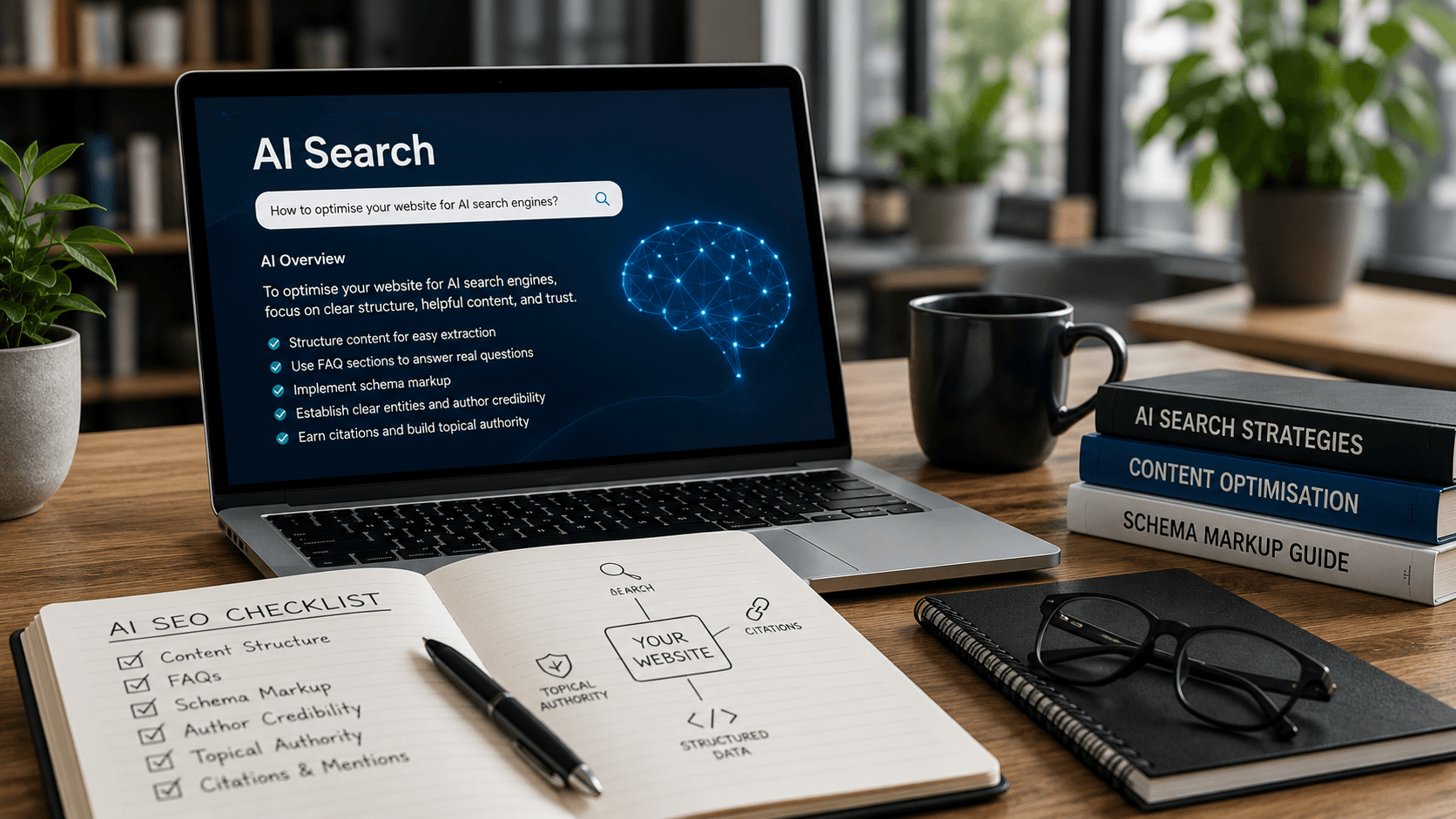
Ranking on Google’s results page and being cited inside an AI-generated answer are related goals, but they’re not identical ones. AI search engines don’t scroll through a page the way a human does, and they don’t return a list of links the way traditional search does, they extract specific claims, facts, and answers, and decide which source (if any) to credit.
This guide covers the practical, page-level changes that make your content easier for those systems to find, trust, and cite.
1. Structure Content For Extraction
AI search systems tend to work in stages: they break a question into smaller sub-queries, retrieve relevant passages from multiple sources, and then synthesise an answer from whichever passages best match the question. That means content structured as clear, self-contained claims is far more useful to them than content structured as a single flowing narrative.
Practical changes:
- Lead each section with a direct, one-to-two sentence answer before expanding into detail, the pattern researchers consistently find has the single biggest impact on citation rates.
- Break long paragraphs into shorter, scannable chunks organised under specific, descriptive headings.
- Add a short summary (a “TL;DR”) near the top of longer articles, so the core answer is retrievable without needing the full page.
- Use tables for anything comparative, pricing, specs, feature comparisons, since tables are unusually easy for these systems to extract accurately.
2. Build Real FAQ Sections
FAQ sections do double duty: they match the literal phrasing of conversational queries, and they package answers into the tight, self-contained format AI engines prefer to quote from.
- Base your FAQs on questions people are actually asking, pull them from “People also ask,” customer support tickets, and sales call transcripts rather than guessing.
- Keep each answer genuinely short and complete, a sentence or two that would make sense entirely on its own, out of context.
- Mark FAQs up with FAQ schema (see below) so both traditional and AI search engines can parse them reliably.
3. Establish Clear Entities
“Entity” is SEO shorthand for a specific, identifiable thing, your business, your product, your author, a person, a place, that a search engine can recognise and connect across multiple sources. AI systems lean heavily on entity recognition to decide whether a claim is trustworthy and where it fits in the broader web of information about a topic.
- Keep your business name, address, and other identifying details consistent everywhere they appear online (your site, directories, social profiles).
- Use a proper Organization or Person schema so your brand and named authors are explicitly identifiable, not just implied by context.
- Make sure named authors have a real, consistent presence – a bio page, consistent byline formatting, and a visible publish/update date on every article.
4. Implement Structured Data (Schema)
Schema markup is one of the clearest, lowest-effort ways to help AI systems parse your content correctly. Priority schema types for most content sites:
- Article – for blog posts and guides, including author, publish date, and update date.
- FAQPage – for any dedicated FAQ section.
- Product / Offer – for e-commerce pages, including price, availability, and reviews.
- Organization – for your homepage and about page, tying your brand identity together.
- BreadcrumbList – to reinforce your site’s topical hierarchy.
Validate every schema implementation with a structured data testing tool before publishing; having broken or mismatched schema can do more harm than having none at all.
5. Earn Citations, Not Just Rankings
Because several major AI platforms weight citation-worthiness heavily, the presence of genuine external references matters more here than it typically does for traditional SEO alone.
- Publish original data. A proprietary survey, benchmark, or dataset gives an AI engine little choice but to cite you when that specific statistic comes up in an answer; this is consistently cited as the single most effective lever available.
- Get mentioned on other credible sites. Guest posts, expert commentary, and founder bylines on relevant industry publications build the kind of cross-web brand signal these systems use to judge trustworthiness.
- Keep content fresh. Several platforms, Perplexity in particular, visibly favour recently updated content, so revisiting and refreshing older articles pays off.
6. Build Genuine Topical Authority
A single well-optimised page rarely earns consistent citations on its own. AI systems, like traditional search engines, look for evidence that a site has real depth on a subject, not just a single lucky page.
- Organise content into topic clusters, a comprehensive pillar page supported by a set of related, thoroughly interlinked articles (see our guide on finding keywords that actually drive customers for how to map these clusters).
- Avoid orphan pages with no internal links pointing to them, both search crawlers and AI bots use internal linking to gauge how deep your coverage of a topic really goes.
- Resist the temptation to publish recycled summaries of other people’s work, AI systems generally cite original sources over content that simply repackages them.
7. Track What’s Actually Working
Traditional rank tracking won’t tell you whether you’re being cited in AI answers, so measurement needs a different approach:
- Manual prompt audits. Pick 20–30 realistic questions your customers might ask, run them across ChatGPT, Perplexity, Gemini, and Google AI Overviews, and record which sources get cited. Repeat monthly.
- AI referral tracking. Set up a custom channel grouping in your analytics tool that captures traffic from ChatGPT, perplexity, Gemini, Claude, and copilot referrers as a distinct segment.
- Server log monitoring. Watch for AI crawler activity (OAI-SearchBot, PerplexityBot, ClaudeBot, GPTBot, Google-Extended), a rising count means your content is being actively indexed for these systems; a flat line means it isn’t.
Bringing It Together
None of this replaces the fundamentals covered in our SEO audit guide and on-page SEO mistakes guide, a technically sound, well-structured, genuinely useful site is still the foundation both traditional and AI search engines build their trust on.
What’s changed is that structure, clarity, and verifiable authority now carry even more weight than they used to, because they’re exactly what determines whether an AI system chooses to quote you, or quote a competitor instead.