
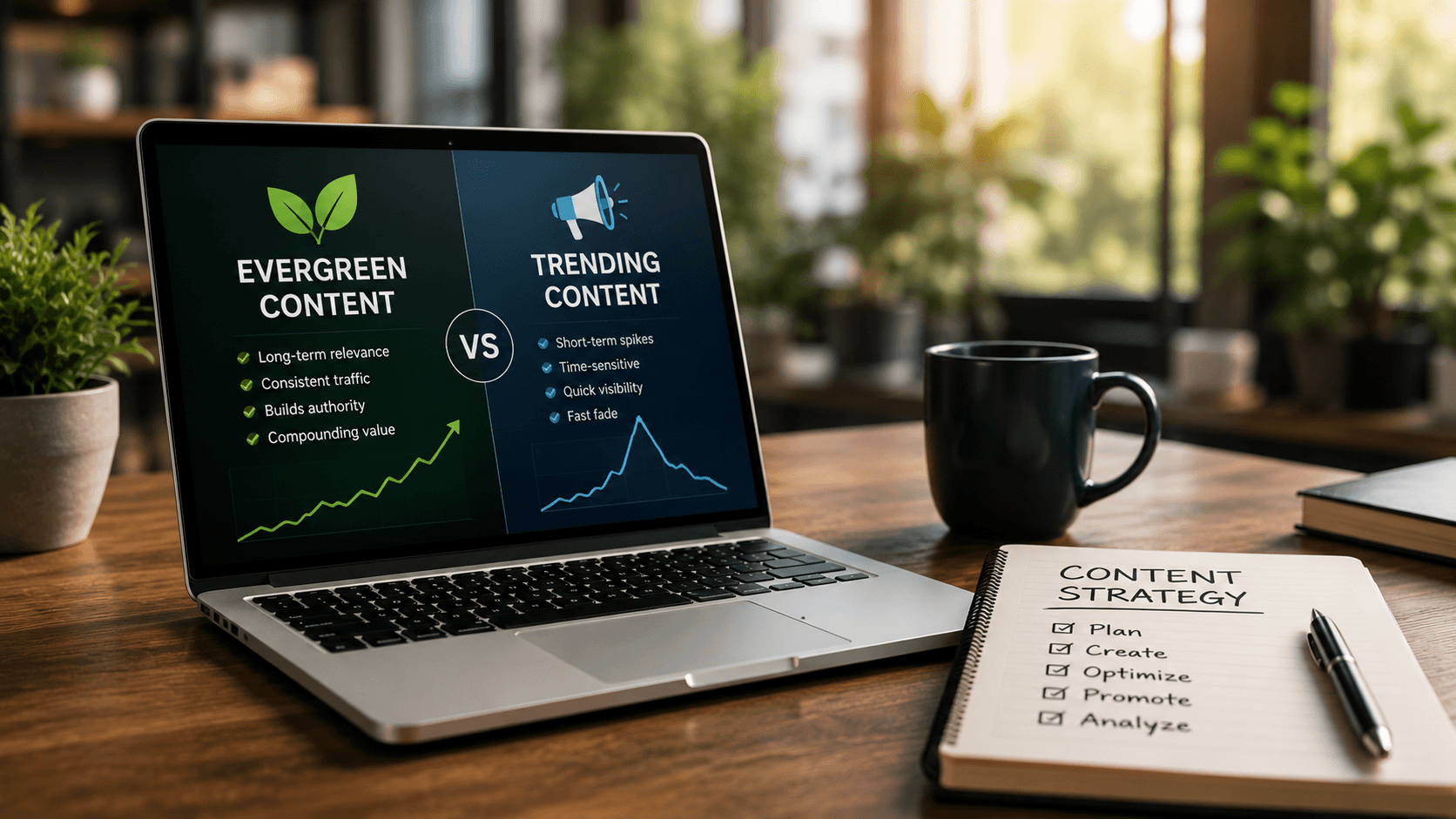
Both evergreen and trending content have a place in a healthy content strategy, but they behave completely differently and treating them the same way (same production process, same success metrics, same publishing cadence) is one of the most common reasons content plans underperform.
Here’s how each actually behaves, and how to decide where to put your effort.
Evergreen Content: Slow Build, Long Payoff
Evergreen content covers topics that stay relevant regardless of when someone reads them and “how to,” definitional, and comparison content that answers a question people will keep asking for years. Think of our own website traffic guide, or guide to finding keywords that actually drive customers: the specific tools and platforms mentioned might shift over time, but the underlying questions don’t go away.
How it performs:
- Traffic builds gradually, often taking months to reach its full potential as a page accumulates rankings, backlinks, and internal links.
- Once established, it tends to produce a long, stable tail of traffic rather than a sharp peak, a well-ranked evergreen guide can keep bringing in visitors for years with minimal ongoing effort.
- It compounds: each new evergreen piece adds to your site’s topical authority, making the next piece in the same cluster easier to rank.
Where it falls short:
- It takes real time to pay off, which can be frustrating if you’re expecting quick wins.
- Without occasional updates, evergreen content quietly goes stale, facts, screenshots, and recommendations age even when the core topic doesn’t.
Trending and News Content: Fast Spike, Fast Fade
News content covers something happening right now, an algorithm update, a product launch, an industry event. It can generate a real burst of traffic very quickly, particularly if you publish early and it gets picked up or shared.
How it performs:
- Traffic can spike dramatically within days, sometimes hours, especially if you’re one of the first credible sources covering the topic.
- That spike almost always fades fast, once the news cycle moves on, so does the search interest, and the page’s traffic usually drops close to zero.
- It can be genuinely valuable for brand visibility, backlinks, and social sharing in the short term, even if the long-term SEO traffic is minimal.
Where it falls short:
- The traffic is largely one-time. A news post rarely becomes a durable, ongoing traffic source the way an evergreen guide does.
- It requires speed, being three days late to a trending topic usually means missing the spike almost entirely.
Seasonal Content: A Middle Ground
Seasonal articles (“Best Gifts for X Holiday,” “Q4 Planning Checklist”) sit between the two. They don’t provide the sharp, one-off spike of pure news content, but they’re not truly evergreen either — instead, they produce a predictable, recurring bump in traffic at the same time each year.
The key with seasonal content is treating it as a reusable asset rather than a one-off: update the same page annually (new year, refreshed recommendations, updated data) rather than publishing a brand-new version each time. This lets the page accumulate authority year over year, so each season’s traffic peak tends to be higher than the last.
Updating Existing Content: The Most Underrated Lever
The most reliable traffic gains often don’t come from choosing evergreen or trending, they come from returning to content you’ve already published and making it better. A page that already has some rankings, backlinks, and search visibility can frequently be pushed meaningfully higher with a focused update, for far less effort than starting from scratch.
Worth updating regularly:
- Evergreen guides with outdated screenshots, statistics, or recommendations.
- Seasonal content, refreshed each year rather than replaced.
- Older posts that are ranking on page two, where a content and structure refresh (see our on-page SEO mistakes guide) can be enough to push them onto page one.
This matters even more now that several AI search platforms visibly favour recently updated content when deciding what to cite, a stale but historically strong page can lose ground in AI-driven search well before it loses ground in traditional rankings.
So Which Actually Gets More Traffic?
Over any meaningful time horizon, evergreen content wins on total traffic, because it keeps earning visits long after publication instead of spiking and fading. But the honest answer is that the highest-performing content strategies don’t pick one:
- Evergreen content should form the backbone of your site, the topic clusters and pillar pages that build lasting authority (see our keyword research guide for how to map these).
- Trending content is worth pursuing opportunistically, when you can move fast and it aligns with a topic you’re already credible on, treat the traffic spike as a bonus, not the primary goal.
- Seasonal content is worth building once and maintaining annually, rather than reinventing each year.
- Regular updates to your existing evergreen library are frequently the single best use of limited content resources, since the authority-building work has already been done.
The mistake to avoid is chasing trending topics as your primary strategy, it can feel productive because of the fast traffic spikes, but it rarely builds the durable, compounding organic presence that evergreen content does.